Physics Notes - Herong's Tutorial Notes - v4.01, by Herong Yang
What Is Electric Field
This section provides a quick introduction of electric fields.
What Is Electric Field? An Electric Field is the distribution of force potential in space on electrically charged objects. Electric fields can be created by an electrically charged objects.
An electric field is represented by a vector function E. At each point (x, y, z) in the electric field, vector E(x, y, z) represents the direction and strength of the electric field. E(x, y, z) is defined as:
where:
        E(x, y, z) is the electric field vector
        F(x, y, z) is the force vector exerted on a test charge
        q is the test charge at the point (x, y, z)
As we can see from the definition, electric field is really a force field per unit of charge at each point in the space.
The above equation can be expressed in simpler forms:
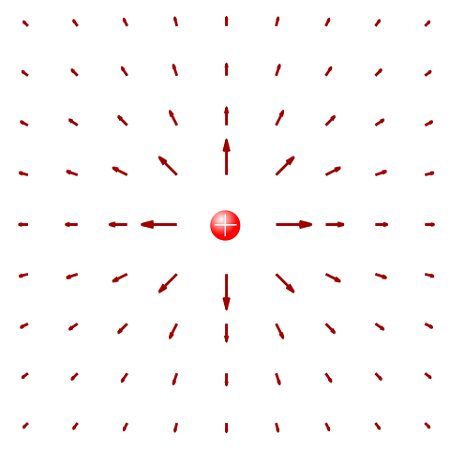
The diagram below illustrates an electric field created by a positive point charge, for example a proton.
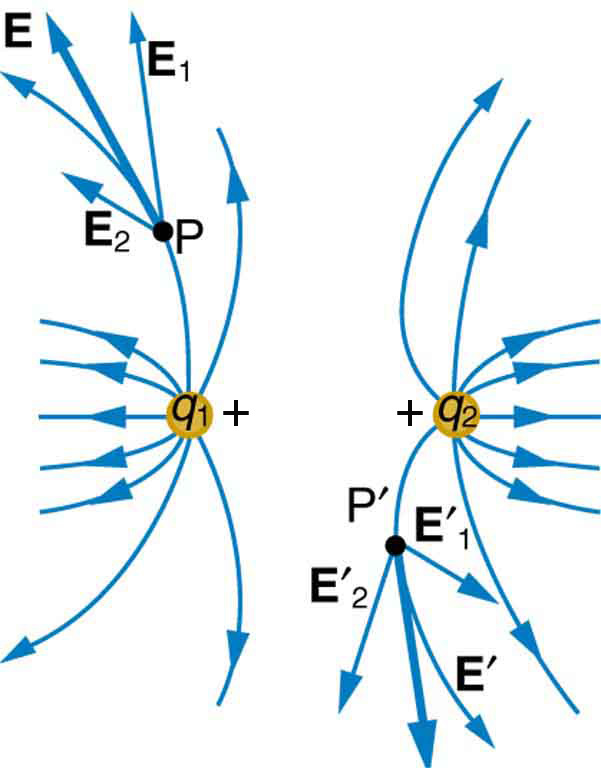
If we put 2 point charges, q1 and q2, in the space, they will create 2 electric fields, E1 and E2. Their superposed electric field, E can be obtained by the vector addition:
E = E1 + E2
The diagram below illustrates the superposed electric field created by 2 positive point charges.
What Is Coulomb's Law? The force between 2 point charges is proportional to strengths of both charges and inversely proportional to square of their distance.
The direction of the force is pushing them away from each other, if they are both positively charged or negatively charged. The direction of the force is pulling them together, if they have opposite charges.
Coulomb's law (for the magnitude of the force) can be expressed as below::
where:
        F is the force exerted on each charged object in N (newton)
        k is the Coulomb constant (8.99 × 10⁹)
        q1 is the first point charge in C (coulomb)
        q2 is the second point charge in C (coulomb)
        r is the distance between the charges in m (meter)
Note that the Coulomb constant k is related the vacuum permittivity ε0, which measures how an electric field forms in a vacuum. Vacuum permittivity is also called electric constant.
So the magnitude of the force between 2 point charges can also be expressed as:
where:
        4πkε0 = 1
        ε0 is the vacuum permittivity (8.85 × 10⁻¹²)
Coulomb's law can also be written in vector forms:
where:
        F12 is the force vector exerted on q2
        F21 is the force vector exerted on q1
        r12 is the distance vector from q1 to q2
        r21 is the distance vector from q2 to q1
How to Calculate Electric Field of a Point Charge? Based on Coulomb's Law, we can now derive the formula to calculate the electric field of a point charge.
Consider the first charge as the point charge and the second charge as the test charge. Then we can start with the electric field definition:
Replace the force vector F12 with Coulomb's Law:
Now drop the subscripts, we have a simple vector formula to calculate the electric field of a single charge:
where:
        q is the point charge
        r is the distance vector from point charge to test charge
Or transform it to use the vacuum permittivity:
Table of Contents
Introduction of Frame of Reference
Magnetic Force on Moving Charges
Moving Charge Creating Magnetic Field
Biot-Savart Law for Magnetic Fields
Magnetic Fields of Current Carrying Loops
What Is Magnetic Dipole and Moment
Introduction of Special Relativity
Time Dilation in Special Relativity
Length Contraction in Special Relativity
The Relativity of Simultaneity
Minkowski Spacetime and Diagrams
Introduction of Generalized Coordinates