Physics Notes - Herong's Tutorial Notes - v4.01, by Herong Yang
Magnetic Force on Wire Rod
This section describes the force exerted on moving electric charges by a magnetic field.
Since magnetic field exerts force on moving charges and electric current is made of fast moving charges, a wire rod with running current will experience magnetic force in a magnetic field.
Current, I, is defined as the total charge passing through a cross section of the wire per second:
        I = nqAv
where:
        n is the number of moving electrons per volume
        q is the charge of an electron
        A is the area of the cross section of the wire
        v is moving speed of electrons
To calculate the total magnetic force on a wire rod, we can start with a single moving electron presented in the previous section:
Fq = q(v × B)
Since the total number of electrons moving in the rod is nAL, the total magnetic force on the rod is:
        F = nALq(v × B)
           = L(I × B)
where:
        L is the length of the wire rod
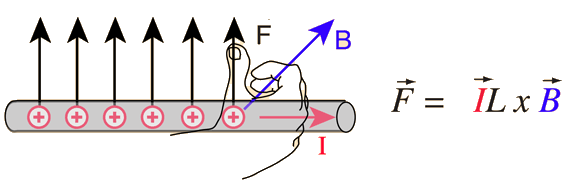
Table of Contents
Introduction of Frame of Reference
Magnetic Force on Moving Charges
Moving Charge Creating Magnetic Field
Biot-Savart Law for Magnetic Fields
Magnetic Fields of Current Carrying Loops
What Is Magnetic Dipole and Moment
Introduction of Special Relativity
Time Dilation in Special Relativity
Length Contraction in Special Relativity
The Relativity of Simultaneity
Minkowski Spacetime and Diagrams
Introduction of Generalized Coordinates