Java Swing Tutorials - Herong's Tutorial Examples - Version 4.11, by Dr. Herong Yang
Editing HTML in an Editor Pane
This section provides a tutorial example on how to use the setContentType() method of the javax.swing.JEditorPane class to set force the editor pane to display content in HTML format.
Now I want to try the "text/html" content type with the javax.swing.JEditorPane class. In this tutorial example, I want to add a new menu, "View", with two functions, "HTML" and "Plain". If you click HTML, the text in the editor pane will be displayed in HTML format. If you click Plain, the text in the editor pane will be displayed in plain text format. Of course, this is done by using the setContentType() of the JEditorPane class.
/* JEditorPaneHtml.java
 * Copyright (c) 2014, HerongYang.com, All Rights Reserved.
 */
import java.io.*;
import java.nio.*;
import java.awt.event.*;
import javax.swing.*;
public class JEditorPaneHtml implements ActionListener {
   JFrame myFrame = null;
   JEditorPane myPane = null;
   public static void main(String[] a) {
      (new JEditorPaneHtml()).test();
   }
   private void test() {
      myFrame = new JFrame("JEditorPane HTML Test");
      myFrame.setDefaultCloseOperation(JFrame.EXIT_ON_CLOSE);
      myFrame.setSize(300,300);

      myPane = new JEditorPane();
      myPane.setContentType("text/html");
      myPane.setText(
         "<p><b>JEditorPane</b> is a text component to edit various"
         +" kinds of content.\n\nThis component uses implementations"
         +" of the EditorKit to accomplish its behavior.</p>");
      myFrame.setContentPane(myPane);

      JMenuBar myBar = new JMenuBar();
      JMenu myMenu = getFileMenu();
      myBar.add(myMenu);
      myMenu = getViewMenu();
      myBar.add(myMenu);
      myFrame.setJMenuBar(myBar);
      myFrame.setVisible(true);
   }
   private JMenu getFileMenu() {
      JMenu myMenu = new JMenu("File");
      JMenuItem myItem = new JMenuItem("Open");
      myItem.addActionListener(this);
      myMenu.add(myItem);

      myItem = new JMenuItem("Save");
      myItem.addActionListener(this);
      myMenu.add(myItem);
      return myMenu;
   }
   private JMenu getViewMenu() {
      JMenu myMenu = new JMenu("View");
      ButtonGroup myGroup = new ButtonGroup();
      JMenuItem myItem = new JRadioButtonMenuItem("HTML");
      myItem.setSelected(true);
      myItem.addActionListener(this);
      myMenu.add(myItem);
      myGroup.add(myItem);

      myItem = new JRadioButtonMenuItem("Plain");
      myItem.addActionListener(this);
      myMenu.add(myItem);
      myGroup.add(myItem);

      return myMenu;
   }
   public void actionPerformed(ActionEvent e) {
      String cmd = ((AbstractButton) e.getSource()).getText();
      String text = null;
      try {
         if (cmd.equals("Open")) {
            FileReader in = new FileReader("JEditorPane.txt");
            char[] buffer = new char[1024];
            int n = in.read(buffer);
            text = new String(buffer, 0, n);
            myPane.setText(text);
            in.close();
         } else if (cmd.equals("Save")) {
            FileWriter out = new FileWriter("JEditorPane.txt");
            out.write(myPane.getText());
            out.close();
         } else if (cmd.equals("HTML")) {
            text = myPane.getText();
            myPane.setContentType("text/html");
            myPane.setText(text);
         } else if (cmd.equals("Plain")) {
            text = myPane.getText();
            myPane.setContentType("text/plain");
            myPane.setText(text);
         }
      } catch (Exception f) {
      	 f.printStackTrace();
      }
   }
}
If you run this example, you will see a text editor pane displayed with the initial text content and a menu bar with the "File" menu and the "View" menu.
Initially, the content is displayed in HTML format. the <b> tag is properly processed. You can <b>The End</b> at the end.
If you click the "Plain" command in the "View" menu, the content will be displayed in plain text,
the original HTML source code as shown in the picture below:
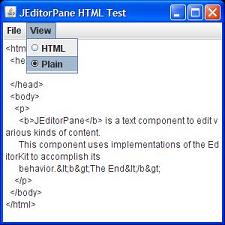
Interesting notes about this tutorial example:
- setContentType() method will actually remove the current text content in the editor pane. This is why I have save the content into a variable first.
Sample programs listed in this section have been tested with JDK 1.6.0 to 1.8.0.
Last update: 2014.
Table of Contents
Introduction of Java Swing Package
Graphics Environment of the Local System
JRadioButton - Swing Radio Button Class
JTextField - Swing Text Field Class
Menu Bar, Menus, Menu Items and Listeners
Creating Internal Frames inside the Main Frame
Layout of Components in a Container
►JEditorPane - The Editor Pane Class
Creating a Simple Plain Text Editor Pane
Saving Text from an Editor Pane
►Editing HTML in an Editor Pane
Editing Unicode Characters in an Editor Pane
javax.swing.JFileChooser - File Chooser Dialog Box