Physics Notes - Herong's Tutorial Notes - v4.01, by Herong Yang
What Is Light
This section provides a quick introduction of light, which is a form of energy traveling in the space.
What Is Light? Light is a form of energy traveling in the space.

Structurally, light is made of discrete packets of electromagnetic wave call photons, represented by the symbol γ (gamma). So light is also referred as a form of electromagnetic radiation.
Main properties of photon are:
- Photon has a wavelength, λ (lambda), defined as the distance between two peaks of its electric field wave.
- Photon has a frequency, ν (nu), defined as the number of peaks of its electric field wave passing a fixed location in a second.
- Photon travels at a constant speed of c = 299,792,458 m/s.
- Photon's wavelength is inversely proportional to its frequency: λ = c/ν, or c = νλ
- Photon's energy, E, is directly proportional to its frequency: E = hν, where h (6.62607015 × 10⁻³⁴ J/Hz) is the Planck constant.
- Photon's amplitude, A, is related to its frequency as A2 = h/ν, or E = (Aν)2.
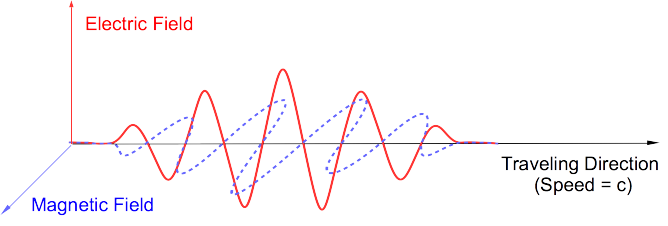
- The oscillation direction (polarization direction) of photon's electric field wave is fixed at a 90 degree angle to the traveling direction.
- The oscillation direction of photon's magnetic field wave is fixed at a 90 degree angle to the traveling direction and the oscillation direction of the electric field wave.
- The electric field wave and the magnetic field wave have the same frequency and travel in phase.
- Photon is mass-less.
The following digram illustrate the structure of a single photon.
A simplified version of the diagram without the magnetic field wave is often used to represent a single photon:
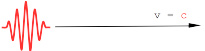
Table of Contents
Introduction of Frame of Reference
Light Spectrum - Range of Electromagnetic Frequencies
Stimulated Emission of Radiation and Laser
Superposition of Electromagnetic Field Waves
Types of Photon-Atom Interactions
Light Interacting with Flat Surface
Introduction of Special Relativity
Time Dilation in Special Relativity
Length Contraction in Special Relativity
The Relativity of Simultaneity
Minkowski Spacetime and Diagrams
Introduction of Generalized Coordinates