Astrology Notes - Herong's Notes - v2.13, by Herong Yang
The Precession - Rotation of Earth's Axis
This section describes the precession, rotation of Earth's axis.
In astronomy, precession refers to the rotation of Earth's axis.
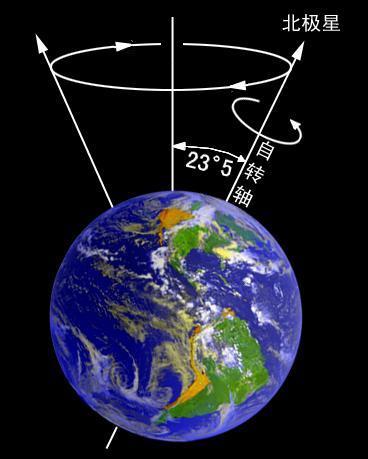
As we learned from the previous section, Earth's axis has an inclination angle of about 23.5 degree, known as the obliquity of the ecliptic. But in which direction Earth's inclination is pointing to? The answer is that Earth's inclination has no fixed direction. Earth's inclination is turning slowly like a spinning toy top.
Two important notes to remember about Earth's precession:
- While Earth's axis inclination is slowing turning, but inclination angle is not changing. That means, the intersection of Earth's axis on the celestial sphere is a small circle with an angular radius of about 23.5 degree.
- The speed of Earth's precession is slow, about 25,765 years for a full turning circle.
The diagram below provides you a nice illustration of the precession of Earth's axis:
There are three main surprises because of the precession of Earth's Axis:
1. The equinoxes, intersection points of the celestial equator circle and ecliptic circle, are moving each year because of the precession of Earth's Axis. This movement is also called precession of the equinoxes. Of course, the speed of the equinoxes movement is the same as the Earth's axis rotation, about 25,765 years for a full turning circle, or 71.57 years for 1 degree.
Greek astronomer, Hipparchus first observed the precession of the equinoxes and estimated about 100 years for 1 degree about 200 BC.
2. Our calendar year is not exactly equal to the time for a full rotation of Earth around the Sun. This is because our calendar year is based the direction of Earth's inclination. More precisely, our calendar year, called tropical year, based on the time for the Sun to return the same equinox. While the time for a full rotation of the Earth around the Sun, called sidereal year (star year), is not affected by the precession of the Earth's Axis.
To calculate the difference of a tropical year and a sidereal year can be done simply using the precession speed. The following calculation tells us that a tropical year, our calendar year, is about 20 minutes and 24 seconds shorter than a sidereal, a star year:
  25,765 years : 1 year (365.25 days)
=      1 year  : 0.014176 days
=      1 year  : 20.4 minutes
=      1 year  : 20 minutes and 24 seconds
3. Because of the precession, our North Star, currently the Polaris, will not be the same in 2000 years from now. In year 4000, our North Pole will be pointing the Andromeda constellation.
4. The Sun will not travel through each Zodiac constellation at the same time each year. This will effect the determination of a person's Sun sign in Western astrology.
Table of Contents
Quick Introduction to Astrology
►Basics of Astrology and Astronomy
The Celestial Sphere Coordinate System
The Celestial Meridian and Zenith
►The Precession - Rotation of Earth's Axis
Introduction to Western Zodiac Signs
Horoscope and Horoscopic Astrology