Unicode Tutorials - Herong's Tutorial Examples - v5.32, by Herong Yang
Opening UTF-16BE Text Files
This section provides a tutorial example on how to open a UTF-16BE text file with Word correctly by selecting the Unicode (Big-Endian) encoding option on the File Conversion dialog box.
Now let's try to use Word to open the UTF-16BE text file, hello.utf-16be, created from the previous chapter.
1. Run Word and click menu File > Open. The Open file dialog box comes up.
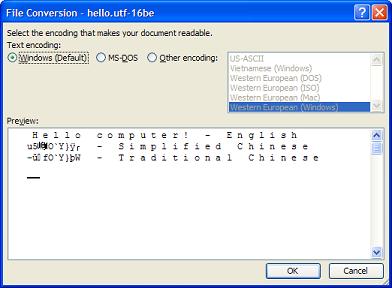
2. Select the hello.utf-16be text file and click the Open button. The File Conversion dialog box comes up automatically. But this time Word failed to detect the correct encoding and suggests you to use the Windows default encoding to read the text file. See the incorrect text in the preview section in the picture below:
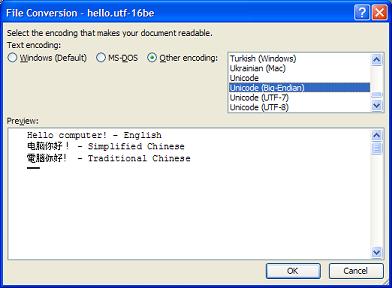
3. Click the "Other encoding" radio button and Select the "Unicode (Big-Endian)" encoding from the encoding list. Word now converts the UTF-16BE text correctly. See the correct text in the preview section in the picture below:
4. Click the OK button. My UTF-18BE text file opens in Word correctly.
Not too bad. This proves that Word can open UTF-16BE text file correctly if the "Unicode (Big-Endian)" encoding option is selected.
Table of Contents
ASCII Character Set and Encoding
GB2312 Character Set and Encoding
GB18030 Character Set and Encoding
JIS X0208 Character Set and Encodings
UTF-8 (Unicode Transformation Format - 8-Bit)
UTF-16, UTF-16BE and UTF-16LE Encodings
UTF-32, UTF-32BE and UTF-32LE Encodings
Python Language and Unicode Characters
Java Language and Unicode Characters
Encoding Conversion Programs for Encoded Text Files
Using Notepad as a Unicode Text Editor
►Using Microsoft Word as a Unicode Text Editor
Saving Files in "Unicode (UTF-8)" Option
Saving Files in "Unicode (Big-Endian)" Option
Saving Files in Unicode Option
Supported Save and Open File Formats