Astrology Notes - Herong's Notes - v2.13, by Herong Yang
Chinese Year Numbering System
This section describes how years are counted in Chinese calendar.
In Chinese calendar, a year is defined as a tropical year or solar year, which is the time for the Sun to return to the same position along the ecliptic circle as viewed from the Earth. This is the same definition as the Western calendar.
But in Chinese calendar, years are counted with a combination of two numbering systems:
- 10 Heavenly Stems - 天干 (tiangan): 甲 (jia), 乙 (yi), 丙 (bing), 丁 (ding), 戊 (wu), 己 (ji), 庚 (geng), 辛 (xin), 壬 (ren), 癸 (gui).
- 12 Earthly Branches - 地支 (dizhi): 子 (zi), 丑 (chou), 寅 (yin), 卯 (mao), 辰 (chen), 巳 (si), 午 (wu), 未 (wei), 申 (shen), 酉 (you), 戌 (xu), 亥 (hai).
When counting years, elements from both Heavenly Stems and Earthly Branches are used continuously in cycles. The first year is 甲子 (jiazi), the second is 乙丑 (yichou), and so on. At year eleven, the first element 甲 (jia) of Heavenly Stems will be used again. So the eleventh year is 甲戌 (jiaxu). Of course, the thirteenth year is 丙子 (bingzi), because the first element of Earthly Branches is used after the last element.
Since the numbers 10 (Heavenly Stems) and 12 (Earthly Branches) have a common factor of 2, only 1/2 of the 120 possible stem-branch combinations actually occur. The resulting 60-year (or sexagesimal) cycle takes the name jiazi (甲子) after the first year in the cycle, being the Heavenly Stem of "jia" and Earthly Branch of "zi".
The starting point (epoch) for the Chinese calendar is 2697 BCE. So year 2007 in Western calendar is the year 4704 in Chinese calendar.
Here is a map to help you convert years between the Chinese calendar and the Western calendar:
Western   Chinese
Year      Year

1990      4687 庚午 马 Horse
1991      4688 辛未 羊 Sheep
1992      4689 壬申 猴 Monkey
1993      4690 癸酉 鸡 Rooster
1994      4691 甲戌 狗 Dog
1995      4692 乙亥 猪 Pig
1996      4693 丙子 鼠 Rat
1997      4694 丁丑 牛 Ox
1998      4695 戊寅 虎 Tiger
1999      4696 己卯 兔 Rabbit
2000      4697 庚辰 龙 Dragon
2001      4698 辛巳 蛇 Snake
2002      4699 壬午 马 Horse
2003      4700 癸未 羊 Sheep
2004      4701 甲申 猴 Monkey
2005      4702 乙酉 鸡 Rooster
2006      4703 丙戌 狗 Dog
2007      4704 丁亥 猪 Pig
2008      4705 戊子 鼠 Rat
2009      4706 己丑 牛 Ox
2010      4707 庚寅 虎 Tiger
Here is a nice stamp to celebrate the Year of the Pig - 2007, issued by Canada:
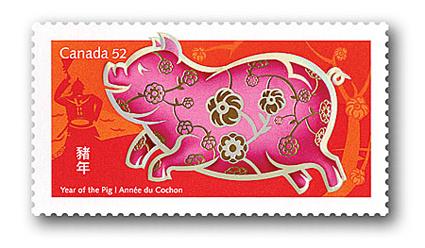
Table of Contents
Quick Introduction to Astrology
Basics of Astrology and Astronomy
Introduction to Western Zodiac Signs
Horoscope and Horoscopic Astrology
►Chinese Astrology and Horoscope
►Chinese Year Numbering System
Solar Terms Used in Chinese Calendar
Chinese Horoscope and Eight Words
Chinese Horoscope Interpretation